Forester: A Line-Sorting Warm-Up Example
Intro
Behavior trees are a mathematical model that helps execute complex, multi-component workflows.
Forester is an orchestration framework that uses behavior trees as a core concept, providing a layer above them that includes a DSL for writing trees, synchronization and asynchronous mechanisms, and more.
The interesting part is how to apply it to real problems in robotics or game design. This article gives a warm-up artificial example.
What is given
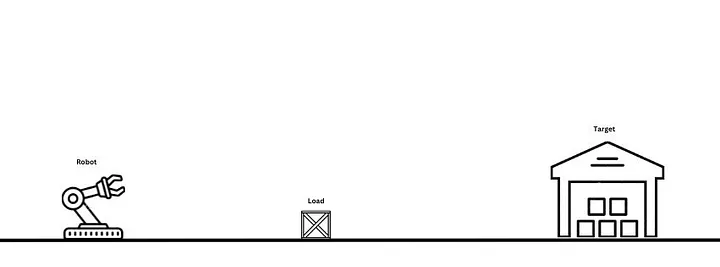
A line to move along. The robot can move across the line either forward or backward.
A robot. It can pick up and place loads, and it moves along the line.
A load. The load sits on the line and can be picked up and placed by the robot.
A target for the load. The goal is for the robot to approach the load, pick it up, and move it to the target position.
Easy. But how precisely?
The program accepts three coordinates (points):
- Robot position (
init_coord) - Load position (
load_coord) - Target position (
targ_coord)
Steps:
- Head off to the initial target — select the right direction and keep moving until the distance between the load and the robot becomes zero.
- Pick up the load.
- Move to the final point — select the right direction and keep moving until the distance between the target and the robot becomes zero.
- Place the load.
Let’s implement it!
Here’s the behavior tree:
import "std::actions"

root main sequence {
    define_env(
        size = 100,
        init_coord = 10,
        load_coord = 80,
        targ_coord = 0
    )
    move_to(load_coord)
    pick()
    move_to(targ_coord)
    place()
}

// initialization for the environment
sequence define_env(size:num, init:num, load:num, targ:num)
{
    store("size", size)
    store("init_coord", init)
    store("curr_coord", init)
    store("direction", 0)
    store("load_coord", load)
    store("targ_coord", targ)
}

// define direction and keep moving until we bump into the target
sequence move_to(target:num){
    define_direction(target)
    retry(size) {
        fallback {
            is_arrived(target)
            inverter move()
        }
    }
}

impl define_direction(target:num);
impl is_arrived(target:num);
impl move();
impl pick();
impl place();
The implementation details for this particular scene are hidden in the actions:
Define direction
Takes the current position and the target position and decides whether the robot needs to go forward (1) or backward (-1):
struct DefineDir;

impl Impl for DefineDir {
    fn tick(&self, args: RtArgs, ctx: TreeContextRef) -> Tick {
        let current = current(&ctx)?;
        let target = target(args, &ctx)?;

        if current == target {
            ctx.bb().lock()?.put("direction".to_string(), RtValue::int(0))?;
        } else if current > target {
            ctx.bb().lock()?.put("direction".to_string(), RtValue::int(-1))?;
        } else {
            ctx.bb().lock()?.put("direction".to_string(), RtValue::int(1))?;
        }

        Ok(TickResult::success())
    }
}
Is arrived
Takes the current position and the target position and compares them:
struct ArrivedCheck;

impl Impl for ArrivedCheck {
    fn tick(&self, args: RtArgs, ctx: TreeContextRef) -> Tick {
        let current = current(&ctx)?;
        let target = target(args, &ctx)?;
        ctx.trace(format!("test if current {current} and target {target} are equal"))?;
        println!("test if current {current} and target {target} are equal");
        if current == target {
            Ok(TickResult::success())
        } else {
            Ok(TickResult::failure("target and current are not eq".to_owned()))
        }
    }
}
Move
Takes the current position and direction and either adds or subtracts the needed amount:
struct Move;

impl Impl for Move {
    fn tick(&self, args: RtArgs, ctx: TreeContextRef) -> Tick {
        let b = ctx.bb();
        let mut bb = b.lock()?;
        let current = bb
            .get("curr_coord".to_owned())?
            .and_then(|v| v.clone().as_int())
            .ok_or(RuntimeError::fail("current is absent".to_owned()))?;

        let direction = bb
            .get("direction".to_owned())?
            .and_then(|v| v.clone().as_int())
            .ok_or(RuntimeError::fail("current is absent".to_owned()))?;

        let step = if direction > 0 { 1 } else if direction < 0 { -1 } else { 0 };
        let next = current + step;
        let _ = bb.put("curr_coord".to_owned(), RtValue::int(next))?;
        ctx.trace(format!("move on one step from {current} to {next}"))?;
        println!("move on one step from {current} to {next}");
        Ok(TickResult::success())
    }
}
Pick and place
Picks the load and places the load:
struct Pick;

impl Impl for Pick {
    fn tick(&self, args: RtArgs, ctx: TreeContextRef) -> Tick {
        ctx.trace("Pick load!".to_string())?;
        println!("Pick load!");
        Ok(TickResult::success())
    }
}

struct Place;

impl Impl for Place {
    fn tick(&self, args: RtArgs, ctx: TreeContextRef) -> Tick {
        ctx.trace("Place load!".to_string())?;
        println!("Place load!");
        Ok(TickResult::success())
    }
}
Why?
Transparency and separation of layers. The actions can be reimplemented and the BT part stays the same.
Modularity and easy implementation. The current BT can be integrated into other BTs while keeping the same state.